How to Remove Red Clay Stains from Concrete in North Carolina
How to Remove Red Clay Stains from Concrete in North Carolina
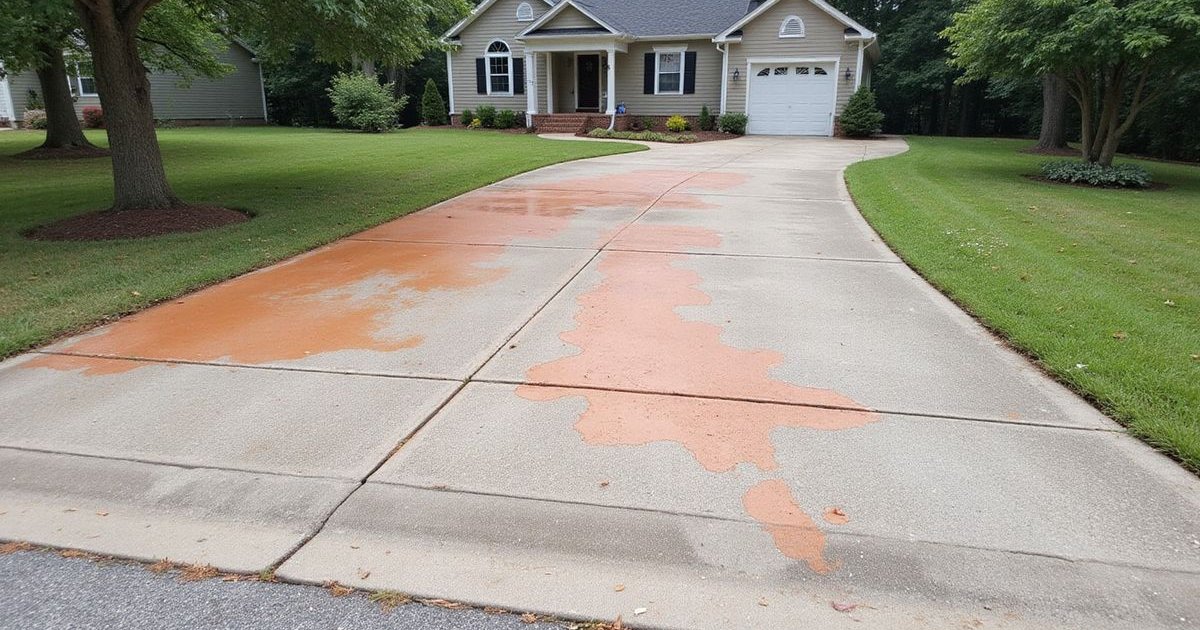
If you live in North Carolina, you know the sight well. We see this every spring and summer throughout the Raleigh-Johnston County corridor. One heavy rainstorm splashes that distinctive red mud onto your driveway, and suddenly your concrete has a permanent orange tint.
Our team has cleaned thousands of driveways, and we know that scrubbing with soap usually does nothing. The problem isn’t dirt; it is a chemical reaction occurring deep within your concrete’s pores.
[AddInfographic]
The Science: Why “Carolina Red” Doesn’t Wash Off
You are battling more than just mud. North Carolina’s official state soil is known as Cecil soil, which is classified by geologists as an Ultisol. This soil is rich in iron oxide, the same chemical compound found in rust.
When this clay sits on porous concrete, the microscopic iron particles migrate deep into the surface. As the water evaporates, the iron oxidizes and bonds to the cement. You aren’t trying to wash away dirt; you are trying to remove a rust tattoo from your driveway.
Common DIY Mistakes (And Why They Fail)
Most homeowners waste time and money on the wrong chemicals. We see three common errors that can actually make the problem harder to fix.
Mistake 1: Relying on Bleach
Sodium hypochlorite (bleach) is fantastic for removing organic stains like mold, mildew, and algae. However, it has absolutely zero effect on inorganic iron oxide. You can pour gallons of bleach on a red clay stain, and it will remain bright orange.
Mistake 2: The Muriatic Acid Risk
Some hardware stores recommend muriatic acid (hydrochloric acid). While it can remove stains, it works by eating away the top layer of your concrete “cream.” If you leave it on too long or mix it incorrectly, you will permanently etch your driveway, leaving it rough and exposed to future damage.
Mistake 3: Pressure Washing Without Chemicals
Using high pressure on a red clay stain is like trying to pressure wash a dye out of a white shirt. You might blast away the surface dirt, but the orange color is chemically bonded to the pores. Using too much pressure (over 3,000 PSI) on these spots can strip the finish off your concrete before it removes the color.
The Professional Removal Process
Removing red clay requires breaking the iron-oxide bond chemically. Our technicians use a specific protocol that ensures the stain is lifted without damaging the concrete surface.
Step 1: Saturation
We start by thoroughly wetting the concrete with water. This fills the deepest pores and prevents the acid cleaner from “flash drying” on the surface, which can cause streaks.
Step 2: Chemical Application
The most effective treatment for NC red clay involves Oxalic Acid or specialized restoration cleaners like F9 BARC (Battery Acid Restoration Cleaner). These solutions convert the insoluble iron oxide into a soluble salt that can be rinsed away.
Step 3: Agitation and Dwell Time
Chemicals need time to work. We brush the solution into the stained area and let it dwell for 5 to 10 minutes. You will often see the bright orange color disappear right before your eyes as the chemical reaction takes place.
Step 4: Low-Pressure Rinse
Once the bond is broken, we use a surface cleaner to rinse the area. High pressure is not needed at this stage; we simply need to flush out the suspended iron particles.
DIY vs. Professional Removal: A Comparison
If you are deciding between renting equipment or hiring a pro, consider the breakdown below based on 2026 market averages for the Raleigh area.
| Feature | DIY Method | Professional Service |
|---|---|---|
| Chemical Used | Big-box store acids (often too weak or too harsh) | Commercial-grade Oxalic/F9 BARC |
| Equipment Cost | $80-$150 (Rental + Chemicals) | Included in service quote |
| Risk Factor | High (Etching concrete or killing grass) | Low (Controlled application) |
| Time Required | 4-6 Hours (Rental, setup, clean, return) | 1-2 Hours |
| Results | Often patchy or incomplete | Uniform, streak-free brightness |
Prevention: Keeping the Clay Away
Once your concrete is clean, you want to keep it that way. We recommend three specific strategies to protect your investment.
Upgrade Your Sealer Standard hardware store sealers often form a film that peels over time. We suggest using a Silane-Siloxane penetrating sealer. These sealers soak into the pores and create a hydrophobic barrier that repels water and clay particles while still allowing the concrete to breathe.
Install a River Rock Buffer Grass often struggles to grow in heavy clay shade areas. Instead of fighting it, dig a 12-inch wide trench along your driveway and fill it with 1-3 inch river rocks. This acts as a filter, catching the mud before rain can wash it onto your concrete.
Address Drainage Issues If water consistently flows across your driveway during storms, you will always fight stains. A simple French drain or adjusting the grade of your landscape can divert that iron-rich runoff away from your hardscapes.
When to Call a Professional
While small spots can be tackled with a pump sprayer and some effort, larger projects require more power. You should consider professional help if:
- The stain covers more than 20% of the driveway.
- The clay has been baked in for more than a year.
- You have high-value landscaping nearby that needs protection.
Our trucks carry hundreds of gallons of water and commercial-grade neutralizing agents to ensure your grass and plants are safe during the cleaning process.
Our Red Clay Removal Process
At Johnston Pressure Washing, we don’t just blast away dirt; we restore your home’s curb appeal. Our professional driveway and concrete cleaning service includes:
- Site Analysis: We identify the specific type of stain (clay, rust, or oil).
- Plant Protection: We pre-soak surrounding vegetation to prevent chemical burns.
- Deep Cleaning: We use professional surface cleaners for an even finish.
- Final Brightening: We apply a post-wash brightener to make the concrete pop.
Get Your Free Estimate
Tired of looking at that orange-tinted driveway? Contact us for a free estimate. We will assess your specific situation and provide honest pricing to get your North Carolina home looking its best again.
Serving Four Oaks, Smithfield, Clayton, Selma, and all of Johnston County.